Friday, 3 January 2014

The Explosive Child

CREDIT TO staceyaltamirano

Some people have described kids as being “difficult, willful, manipulative, attention-seeking, limit-testing, contrary, intransigent, [and] unmotivated” (Greene, 2010), but I challenge you to be a little open minded and read on…
20131229-170558.jpg
I just finished reading (literally 1 hour ago) The Explosive Child by Ross Greene, Ph.D and am totally blown away by the insightfulness and understanding in which he writes about “Explosive” children and the people who live and interact with them daily. Greene characterizes explosive children not as the description in the previous paragraph, but as kids who lack the developmental capability to be flexible, tolerate frustration, and solve problems as other, more developmentally advanced children can. The simple theory is posed that all children will do well if they can. Just as some kids don’t do well in certain areas of mathematics/writing/science, etc… because they can’t (yet), explosive children don’t handle frustrations, aren’t flexible, and don’t solve problems well (as simple as they may seem to us) because they can’t (yet).
Without rewriting whole chapters here, I’ll briefly outline the “method” that
Greene poses. Instead of imposing your will onto an explosive child (you will/will not do X) or totally avoiding the situation, use the Collaborative Problem Solving strategy in which you and the child sit down when they are calm and able to think reasonably and identify each other’s concerns and try to come up with mutually satisfactory solutions.
This process is broken down into 3 steps:
1) The Empathy step: gather information from your kid to achieve the clearest possible understanding of his/her concern or perspective on a given un-solved problem
Adult: “I’ve noticed that you aren’t finishing your homework lately. What’s up?”
Child: “My homework is too hard.”
Adult: “So you’re saying that your homework is too hard…what part?”
Child: “The writing part is too hard. I write too slow and my teacher is making me write whole paragraphs. It takes too long and so I forget all my ideas so I’m not going to do it.”
2) The Define the Problem step: enter your concern or perspective into consideration
Adult: “So you’re telling me that you don’t want to do your homework because the writing part is too hard because it takes you a long time to write a paragraph and so you forget your ideas, so you’re not going to do it. My concern is that if you don’t do your writing homework, you’re going to fall behind in writing even more and it will only get harder.”
3) The Invitation step: lets the child know that solving the problem is something you’re doing with him/her rather and to him/her.
Adult: “How about we think of a way that you will be able to get your writing homework done faster and remember your ideas and still do it so that way you don’t fall behind any more.”
Child: “Well, what if I have you write my paragraphs for me?”
Adult: “That is a possible solution, but we tried that before and your teachers wanted you to write them yourself. Could we think of another idea?”
Child: “ Well, sometimes you use a tape recorder to help you remember your ideas for work. Maybe I could use it to record my ideas when I want to write paragraphs.”
Adult: “That sounds like a great idea. I don’t need it when I’m not at work, so you can use it for your homework. Why don’t we try this idea and see if it works. If it doesn’t, then we can talk about it again.”
Obviously there is more to being successful than what I wrote here…especially if the child or teen you are working with has difficulty having a rational conversation…reading the book is a valuable use of your precious time (took me about 3-4 hours) and I cannot wait to put this new way of working with explosive children into practice at my school. If you have an explosive child or if you work with even 1 explosive child, PLEASE, PLEASE read the book and apply the practice to your daily interactions with him/her. Your life and theirs will greatly improve and you will only be setting them up for success.

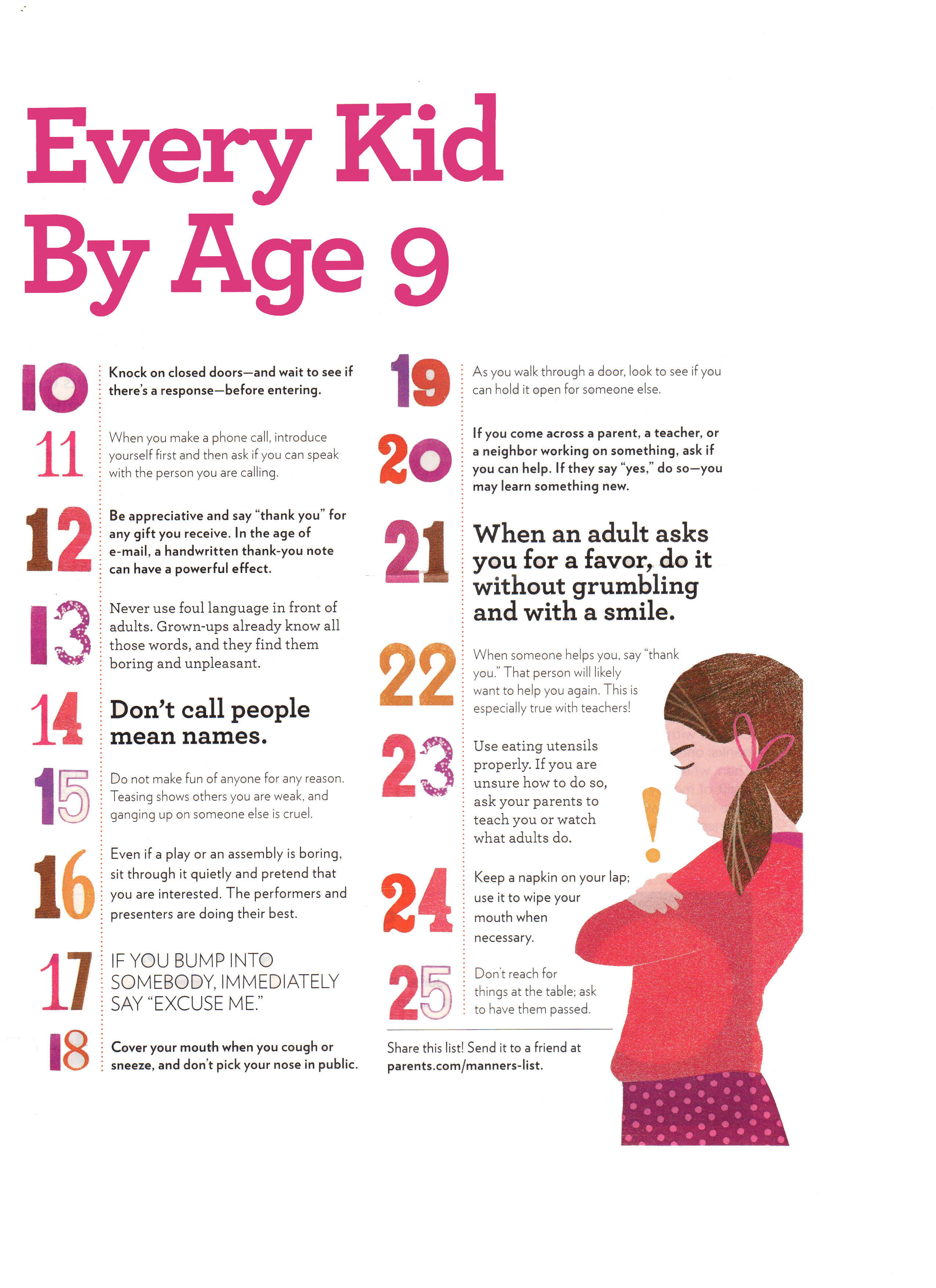
25 Manners Every Kid Needs by Age 9

CREDIT TO staceyaltamirano 


It is amazing how many kids do not use basic manners these days…and I mean little kids all the way to big kids (ie adults!)

my problem is to explain to Alfian what is 'rude'.. Don't think he gets it fully...emm...


Monday, 23 December 2013

Chinese kindergarten or mandarin class hunting for Alfian @Cheras


'SURVEY MEVEY' CHINESE KINDERGARTEN AKA TADIKA CINA DAN MANDARIN CLASS CHERAS

Agak pening ya utk tentukan apa yg terbaik utk anak..cewahh macam iklan susu pulak ayat aku hahahahaa memang pening la cari tadika utk dia ni. so far krista ok alhamdulillah cumanya tahun depan nak cari tadika yg ada mandarin pulak.kalu aku tanya Alfian,semua pun dia suka semua pun dia nak.. tambah lagi kalu sekolah tu besar,cantik n banyak toys..haruslah jadi pilihan hati dia kan heheee..

so cara yg terbaik,setiap sekolah yg aku pilih utk dia,aku akan bawak dia pegi tengok sekali dan aku akan arrange bagi dia cuba sekolah kt situ sehari dua..tengok dia rasa suka ke tak..kalu dia tak suka,cancel ler. taknak paksa2 ni  sebab taknak nanti setahun seksa sengsara nak pegi sekolah hari2 kalu yg dia tak suka kan..kalu da bayar yuran rugi la kalu cancel nanti bukan bole refund semua,ada sekolah yg langsung x dapat refund..lebur duit aku nanti sia2 jek..so aku cari tadika yg ok,buat list dalam  tiga pat lima nam sepoloh ke sekolah..ngehh byk nyee....then bagi dia try nanti nov mana dia suka yg tu la aku daftarkan.

utk tahun 2014 ni,aku nak alfian explore new field,biar dia belajar mandarin dan violin (jenuh nak bayar yurannye anak oi  lol). nanti aku story pasal kelas violin n music lesson ni.now story pasal mandarin dulu..,okehh aku tak letak harapan tinggi utk dia fluent mandarin pun,xmau nak push2 dia..aku just nak dia expose dgn bahasa lain..sebab aku tgk dia cepat pickup bahasa dan numbers.

plan nak hantar dia tadika cina.sebab aku fikirkan kos kalu aku anta dia mandarin course pun dlm 150-200 monthly kan seminggu sekali je kelasnye,better aku anta tadika cina je,ari2 ada cakap mandarin,yuran tambah sikit duit jela..aku cuma nak dia bole bercakap mandarin je..tapi kalu dia bole baca in mandarin is an advantage la,kalu tak..takpe..utk darjah satu aku tak plan lagi nak anta dia sekolah apa..huhuu..kena survey lagi tu!

ni yg aku plan utk dia.umur 5 n 6tahun pi tadika cina,so ada asas mandarin.darjah satu nanti kalau dia bagus mandarin aku anta sek cina tapi kalau kureng jek aku anta sek biasa je la.tapi continue anta dia mandarin class utk maintain kan..ok tak gitu?hehee..bole cari sekolah keb pun ada yg sediakan kelas extra mandarin  atau cari tuition centre luar la.sebab yg aku tau,ada sekolah yg buat additional class utk pelajar yg nak ambik bahasa cina dan tamil,ada sekolah yg ada bahasa arab jugak.yg terdekat dgn rumah sek keb bukit anggerik ada buat mandarin class utk pelajar yg minat.sek alam damai pun ada rasanya..so dr situ dia bole masterkan mandarin dia, insha'allah dia bole bertutur dlm mandarin nanti..amin...

masa darjah satu nanti..slowly akan perkenalkan dia kepada bahasa arab jugak,dia pegi kelas agama nanti darjah satu,akan belajar jawi,arab dan ngaji alquran.Didikan agama penting,itu asas buat anak,kalau dia ada asas yg kuat,insha'allah dapat atasi cobaan duniawi.umpama pokok dgn akar yg kuat,angin tiup kencang pun tetap utuh,akar itu umpama didikan agama,iman yg kuat,angin tu adalah cobaan...cewahh..perumpamaan yg bisa terungkai dgn kata2..hahahaaaaa apakah ini?skema sungguh..lol

mungkin org bole mengata..'alaaa dia tu anta anak belajar cina,baiklah utamakan belajar agama,jgn kejar dunia je' ada pulak yg cakap 'alaaa sekolah agama belum tentu baik,org kt arab tu tau bahasa arab,faham Quran tapi ada penyangak jugak' org bercakap pandai kan..komen itu ini pasal kehidupan org lain,for me..takpe org berhak menilai,sebab ada sesetengah org yg memang suka bazirkan masa menilai diri org lain tanpa sedar nilai diri sendiri..so biarkan la mereka.aku nak yg terbaik utk alfian,aku bagi dia jalan n pilihan,mandarin utk kesenangan dia nak cari rezeki dan arab utk memudahkan dia mendalami ilmu agama,insha'allah kalu dia menguasainya dia akan berjaya.

haishhh.. aku tengah period ke apa ni..macam stress je kan ayat2 di atas..why so serious? hahahaaa
sebenarnya aku stress tak dapat makan donut jco ni!! sebab apa tak dapat makan? sebab aku gemuk dah ni.. kena diet!! harus jaga badan utk yg tersayang..kekal ramping!

haaa melalut2 dah kan..back to d main point pasal tadika cina ni...aku ada survey chinese kindergarten atau tadika yg ada add on mandarin class..banyak aku survey...meh la kita terjah..

jeng jeng...

jeng jeng jeng..

taraa.......

weh banyak la tadika aku survey..penat nak tulis karang ayat ni.bersambung ke episod akan datang la...

OK...SAMBUNG KAT SINI 

http://akulahputeriraja.blogspot.com/2014/08/2014-alfian-di-chinese-kindergarten.html


Monday, 16 December 2013

Top Five Programs on Television for Pre-Schoolers

While television in the past has been known for 'rotting' minds and making children less active, there are programs nowaday that promote exercise, learning and more importantly getting out and being just plain active. with a slew of programming on nowadays for children everywhere, I've compiled a list of what I feel are the five best baby and toddler age programs on television.

Lazy Town
The best way to describe Lazy Town is to simply say it's a program about a small town (that can be from practically anywhere) that is called Lazy Town. The whole story line began when a girl named Stephanie comes to Lazy Town to stay with her uncle. Stephanie notices right away that everyone has the energy of a sleeping slug in town and her uncle tells her about a superhero who wore a number 9 on his jumper. It makes it appear quite clear why the town is named as it is, however, Stephanie is not too happy with how lethargic the other children (who are puppets for lack of a better description) are.
Meanwhile down underneath Lazy Town the 'bad boy' Robbie Rotten takes notice of Stephanie and her desire for activity. In fact, he begins to panic as she clears away a special tube mailbox and shoots a letter straight up in the air in hopes of contacting this number 9 hero. However, as the letter goes up into the air ship you see the hero within wears a 10 - the follow up to 9.
10 introduces himself as Sportacus much to Robbie Rotten's displeasure and he assists Stephanie in getting Lazy Town to be anything but lazy. Through a series of musical songs, different moral lessons like brushing your teeth and eating fruit (code name: sports candy) the show goes well beyond just being active. It teaches the importance of a healthy diet, the value of friendship and the equally important teamwork.
Lazy Town originated in Iceland, the creation of Magnus Sheving, who also plays Sportacus in the television series.
Dora The Explorer
For the past few years Dora has been teaching children more than just basic spanish words. In fact, beyond this little child teaching language, the show features basic map instructions, such as following directions in order to reach their ultimate destination - be it Dora's house or a sporting event. Dora is a cartoon above all else with catchy, easy to remember songs like, "Come on, Vamanos! Everybody let's go!" using the spanish wording right along with its translation.
Dora The Explorer features a small story line but nothing that is really important to the story. Each adventure starts out with Dora introducing herself and her companion, Boots The Monkey. The story progresses into the duo having to go somewhere else for any number of reasons, such as Dora having to go home for her mother's giving birth (which we learn at the end of the show are twins). Dora and Boots have three spots on the map to get to their location. They start out singing the places in order in a way that is easy to remember, such as, "Bridge, Forest, Dora's House" (merely an example, mind you). As they progress through each area a little band of insects play a triumph song and Dora marks off where they're going, such as "We've crossed the bridge. Next comes the Forest!" However, along the way Swiper the Fox may come and try to steal something of theirs to prevent them from completing their task. This reinforces the 'stealing/swiping is wrong' rule.
As Dora and Boots make it to their destination, they complete their task and perform the "We did it" song in triumph. Then comes the small recap, with Dora asking the user what their favorite part of the quest was, then in turn responds with boots.
The Backyardigans
The Backyardigans are rather newish to children, but, already well loved for their uniqueness and musical spectrum. The Backyardigans, unlike other animations on television, are computer graphics. Yes, just like Shrek and Finding Nemo, only on a much shorter scale.
The program has no plotline except for five young animal children (such as Pablo the Penguin, to name one) share a large backyard and many adventures that take place right within that small perimeter. How can these children have adventures in a small area? Simple. This program is about using the imagination to see beyond what is there.
These little children not only sing a wide variety of styles of music such as bebop, country and even rock, but they also weave vague bits of historic accuracy into their stories: such as an adventure in ancient egypt and even an excursion on a pirate ship to find buried treasure.
While the number of children vary depending on what the episode is about, the children display all the right ways to play well with others and make their time together worthwhile. At the end of each episode the children return to reality for snack time, which is always hosted by a different parent per show and the snack is almost always something healthy.
Blues Clues
Blues Clues is definitely one of the older and best programs on Nick Jr. Having gone seamlessly from one host to another citing them as brothers, Blues Clues is basically a guessing game, when you get down to it with various lessons that you learn depending on the show. Some instill waiting, how to make that more fun if you're little such as singing a song, "wait.. wait.. wait!" instead of whining and getting anxious. Blues Clues also shifted into beyond a person in front of a green screen to a three dimensional puppet-like show for a while that was named Blues Room.
Blues Clues features songs that little children can easily pick up and remember and has numerous memorable characters like Mr. Salt and Mrs. Pepper, along with their two children Paprika and Cinnamon.
The program is somewhat fantasy, however also on occasion features a deaf person signing. While it's often normally unnoticed by others, at the end of the program during the end song Joe or Steve sign "thank you" as they sing.
What else does Blues Clues feature? Matching games, season learning and even a large variety of color games - expanding beyond just the standard rainbow colors. Mixing colors to get blue green, for instance.
Blues Clues has been a favorite of children for quite a few years and no doubt will remain one for quite a while longer.
Little Einsteins
Everyone who has watched television or has small children knows that according to research young children advance better when given classical music to listen to. That is the basis of Little Einsteins. Music. Secondly art appreciation.
Little Einsteins are four children, one a conductor, one a ballerina, one a singer and one an instrumentalist who have a flying rocketship that takes them on adventures far and wide - all surrounding one particular classic song and artist. What kind of artists have they used? One of the most memorable episodes I remember watching with my daughter involved Van Gogh's Starry Night. They incorporate the music to fit with the art style as well they can, however, they sometimes give the classical music lyrics. However, most of the times the children pick up on the sound and in no time flat your little one will possibly be humming "Fur Elise" out of the blue.
This also teaches children that not all music has lyrics and stresses the importants of giving proper credit to these geniuses of past.
Little Einsteins have games they play on these adventures, such as guessing what instrument is playing based on sound. This reinforces a child to listen carefully so that they can identify things properly.
The show ends with the children going on stage and applauding the musician, naming the song and composer properly, then applauding the piece of artwork and the respective artist. The show plays out in certain ways like a small orchestra, however, is very addicting to little ones... and even us kids at heart.
Children's Programming has sure increased from the days when Sesame Street and Romper Room were number ones. With all the technological advances such as 3-dimensional programming, these shows not only delight the young ones, but also give the parents a chance to learn some new things too, such as the case with Little Einsteins. Each of these programs has some small similarity to the others, but is genuine in its goal to teach the young. For those parents who think these shows won't amuse you, give them a try and maybe you soon will be singing along with your little ones. While setting a child in front of a television for long periods of time isn't considered a good idea, at least you know if you have to there are excellent programs for your young ones to learn from - almost like pre-school at home.

Using "Lesson Plans with a Letter in Mind" Lessons for Kindergarten and Preschool Age Children

Suggested Supplies and Application of Lessons

Suggestions for using "Lesson plans with a letter in mind" -
These lesson plans are based on one letter of the alphabet per lesson. In most lessons there is an animal, snack idea, color or shape, body part or movement, music, fun activity or arts and crafts, and common sight words (these are words that the student should eventually memorize, by sight). The "lesson plans with a letter in mind" lessons can be used in a variety of ways. For an advanced student, you might want to go thru a lesson every day to three days. For a new or younger student, a letter a week is a better pace. Be sure to alter the lessons to fit your student's needs.
Before you start the ABC lessons, there are a few supplies you will need on hand:
You will need lined paper, for writing letters on every day. This can be printed from your computer, bought at most stores or lined paper you have just drawn the solid and dashed lines onto. Everyday have your student trace doted letters, both capital and lower case, at least 3 times, and try at least two on their own. This is very difficult for a new student, so be encouraging!
Make sure you have plenty of pencils and erasers, as well as a pencil sharpener.
Basic color crayons will work, but more colors equal more fun! You might want some washable markers, watercolors, glue and some basic arts and crafts supplies.
Purchase a large print crossword puzzle book, at least 26 pages long. Everyday tear a page out and circle the letter of the day once. Have your student circle all the rest of that same letter. Young kids really enjoy the treasure hunt of finding the letters. If you run out of pages, you can always re-use the pages a couple of times, just circle with different colors.
Have at least one three-ring binder or folder, to keep your students handwriting in. Keep it in ABC order, so they can see their progression through the alphabet. If you have more than one binder or folder you can easily keep track of your students other prized work.
If your student is attending (or will be) public or private school, be sure to find out what writing style the school uses. There are several varieties and you wouldn't want to be teaching the incorrect way to write the letters.
If you have access to a public library, make a regular time to go, every week. Many libraries have activities such as story time, puppets, and arts and crafts. This is a great socialization tool for your student. Make sure to pick up some books for your letter of the day (or week).
Don't pressure the student, and be sure to use positive reinforcement. You will be surprised to see how fast your young student picks up the ABC's and many other skills.

Piano Lessons: Determining the Perfect Age for Your Child to Begin A Professional Piano Teacher Gives Advice on How to Decide If Your Child is Ready for Piano Lessons

GOOD INFO! :

A Professional Piano Teacher Gives Advice on How to Decide If Your Child is Ready for Piano Lessons


As a Professional Piano Teacher, parents often ask me what age is the best age to begin piano lessons. Since all children have different skills and abilities, the perfect age to begin private piano lessons depends on the individual child.
There are three categories to consider when determining if your child is ready for piano lessons: academic skills, emotional maturity, and natural musical abilities.
What many parents don't understand is how complicated reading music can be. Piano students not only need to know the alphabet from A to G, but they also need to know those seven letters in reverse - G, F, E, D, C, B, A.
For example, the song "Mary Had a Little Lamb" begins with the notes E, D, C. In order for a student to play that song, they must know the alphabet in reverse order from E to C. If your child hasn't mastered the alphabet forwards, doing the alphabet in reverse can be very confusing.
Addition and subtraction are important skills used in music. Music is divided into small sections called measures. Each measure has the same number of beats. Students must first memorize the number of beats each type of note gets (a quarter note is worth one beat, a dotted half note is worth three beats.) Then the student needs to make sure each measure has the correct number of beats by adding the different note values together. If your child cannot do simple math such as 1 + 3 = 4, or 4 - 2 = 2, then they may have difficulty when it comes to counting.
Most piano teachers will have the child's assignment written down in an assignment book. If your child cannot read, it will be your responsibility to sit with the child during their daily practice sessions. It is important to make sure your child is following all of the instructions correctly. If you are not willing, or able, to devote that much time for piano lessons, you should wait until your child is old enough to read the assignment notes and practice on their own.
Emotional maturity is necessary because studying an instrument takes a lot of patience, concentration and repetition. If your child has a short attention span, is unwilling to accept constructive criticism, gets easily frustrated or bored, or is unable to behave during the half hour lesson, then they aren't ready for private piano lessons.
Some children will have natural musical abilities that become apparent early in their lives. You will find these children will dance and clap when they hear music. They will sing songs using the correct pitches. They will naturally be drawn to instruments and attempt to create music that is pleasing to the ear. Typically these children will have a much easier time learning how to play the piano. They would probably benefit from starting piano lessons at a younger age of five to six years old.
I have found that the average child is ready to begin private piano lessons at age seven or eight years old. The Music Teachers National Association (MTNA) website gives this recommendation, "Formal music lessons can begin when students are officially starting formal school, usually first grade."
Some piano teachers specialize in younger ages. They will have special training and methods for teaching younger children which use finger numbers instead of letters. They typically spend much of the lesson time away from the piano playing games and doing floor activities. When choosing a piano teacher, be sure to ask what age the teacher specializes in.
If money is an issue, consider the fact that most eight-year-old students learn in two months what a five or six-year-old learns in two years. Starting your child at an older age can definitely save you a lot of money in lesson fees and materials.
Even if your child isn't ready for formal piano lessons, there are other musical opportunities available for your child. Many Community Education programs offer group music appreciation classes. The Music Teachers National Association recommends that 5-6 year olds enroll in programs that "introduce your child to the instrument, but also involve movement, rhythm activities, singing and more."

Five Reasons to Give Your Children Music Lessons

Confidence and Self Esteem Built Through Learning an Instrument

Children love music. Form the time they are very young children begin to respond to musical sounds or repeated melody lines with smiles and their own vocalizations. With even marginal small motor skills they add to their delight in music by banging on a drum , plunking a piano key or strumming on a toy guitar. For school age children, musical opportunities take on a more structured format. Through school, community or private venues music lessons are available that can help transform enthusiastic young people into skilled musicians. But giving your child the gift of music lessons can also provide five benefits you may not have yet considered.
1. Music lessons connect young people with the sheer joy o music. Stimulating the mind and the imagination through sound, music is a language all its own. For young people, music lessons are the first and most important step to making that language their very own. The joy of playing a musical instrument can last a life time. The basics learned as a fourth or fifth grader open the door to more advanced participation in bands, orchestras or combos in junior and senior high school and possibly even into college. Even more important learning the fundamentals involved in playing and instrument allow children to make the joy of music their very own.
2. Music lessons can help children to build confidence and self esteem. Children taking music lessons learn to play notes sequentially from lesson to less. With each simple skill they acquire children add to their own pyramid of musical knowledge and achievement. Learning to play even that very first note provides its own unique sense of accomplishment. Children can listen to and marvel at their own strides. Playing "Twinkle, Twinkle Little star is truly miraculous for someone who a few weeks ago didn't know how to h old an instrument in the correct fashion. As a regular activity in a child's weekly schedule music lessons give children the structure within which they will gradually build confidence and self esteem. For children who may be struggling even at an early age with academics or with social adjustment, music provides an avenue for success and socialization with other fledgling musicians.
3. In a world where they may feel bombarded by violent or highly competitive activities, children are likely to find that music lessons provide skills that can be used to build their own calm, peaceful and enjoyable leisure activity. There are many children who do not feel drawn to hard hitting or confrontational sports or games ore even the computerized versions of such games. Providing your child music lessons may well mean giving them an option for the productive and enjoyable use of their free time. In time music lessons can help your child to build the kind of skills that will allow him or her to participate in a band or other musical ensemble. There your child will find large numbers of other young people who have discovered the joy and sense of personal accomplishment that music lessons can bring into their lives.
4. Parents want their children to grow not just in stature but also in their seen of responsibility. Music lessons can help children to become less dependent on adults and more likely to take charge of their own free time. Attending music lessons requires that children practice between sessions. As a results children learn to make decisions and choices about how, where and when they will practice. They will learn that to be successful at the next lesson they have to develop a personal schedule for practice and then they have to stick with it. According to the instrument that your child selects, he or she will have to learn the basic care and maintenance neede to keep the instrument performance ready. Perhaps more than anything they have experienced before , music lesson truly belong to children and this sense of ownership can encourage young people to develop both personal discipline and responsibility.
5. Music lessons can give you and your child a new place to bond. Even though you as the parent are not taking music lessons yourself the experience is something you can actively share, encourage and nurture. Listening in and providing encouragement as your child struggles with a new tune can create a new bond of two way respect . Taking your child to a concert where his or her instrument is featured prominently can give re-enforcement to your child's willingness to develop skills. Providing CD's, even borrowed ones from the library , unexpectedly can show your child your interest and may help you to get a better comprehension and appreciation for his or her own growth as a musician. And of course attending any and ll performances in which your child takes part and then sharing the highlights and the low can help you and your child to see each other with new eyes and new respect.
Music lessons and the skills which they help to produce can give you a new road into the mind, heart, imagination and life of your child. Your openness to music lessons and music in your child's life may help your children to see you in a new way as well.